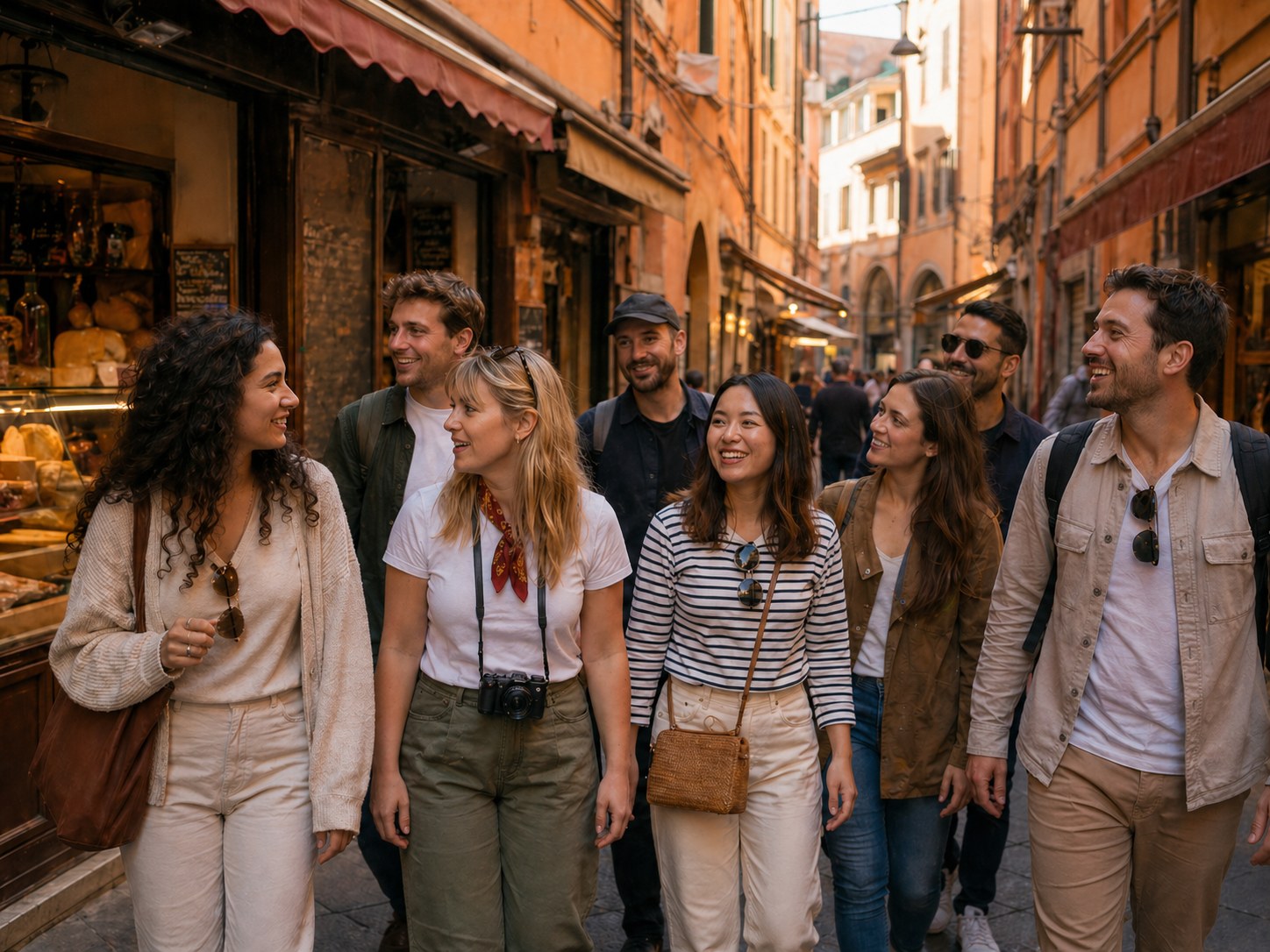
Bologna tends to surprise people. Visitors come for the food and discover a city with 40 kilometres of covered porticoes, one of the oldest universities in the world, a complex medieval skyline, and a political history that's informed the way Italy thinks about itself for centuries. It is a university city, a food city, a city of markets and of communism and of extraordinary cured meats. It is almost never boring.
Here's what to do when you're there.
Walk the porticoes
Bologna's covered walkways — the portici — are a UNESCO World Heritage Site and the defining feature of daily life in the city. There are 40 kilometres of them, connecting palaces and streets and markets and churches and hospitals. They originated in the medieval period for a very practical reason: with the oldest university in the world drawing students from across Europe, landlords built extensions out over the street to create extra rooms to rent. What began as timber overhangs became, over centuries, the stone arcades that now define the city.
The most famous stretch is the portico of San Luca: 3.5 kilometres of continuous arcade climbing the Colle della Guardia from the Porta Saragozza gate to the Basilica of San Luca on the hill above the city. 666 arches, completed in the 18th century. Walk up on a weekday morning when it's quiet. The view over Bologna from the basilica is exceptional.
In the centre, walk Strada Maggiore, Via dell'Indipendenza, and the older medieval streets around the university quarter. Each block has a different style of portico — medieval brick, Renaissance stone, Baroque marble — and the architecture tells the economic history of the city in chronological order.
Climb the Asinelli Tower
Two medieval towers dominate the Bologna skyline: the Asinelli (97 metres, leaning slightly) and the Garisenda (much shorter, leans considerably more). Bologna once had over 100 of these towers — symbols of wealth and power for the noble families who built them in the 12th and 13th centuries. Most were demolished. These two remain.
The Asinelli is currently closed for restoration works — check before planning your visit, as access depends on when the works are completed. When it reopens, it's worth it: 498 steps, a wooden staircase, and a view over the terracotta rooftops that is unlike anything else in Italy.
Spend a morning at the Quadrilatero
The Quadrilatero is the food market at the heart of the old city, stretching through the medieval streets between Piazza Maggiore and Strada Maggiore. It's been a market since the medieval period: the street names still record the trades that operated here — Via Pescherie Vecchie (old fishmongers), Via Drapperie (drapers), Via Caprarie (goat dealers).
Today it is a mix of old food shops — some operating in the same location for a century or more — alongside newer delis, produce sellers and wine merchants. Come in the morning, before 11, when it's at its liveliest. Eat standing up at the counter of a salumeria. Buy mortadella. Watch how Bolognese people shop.
Aperitivo — the daily ritual
Aperitivo in Bologna is not what it has become in Milan (elaborate buffets, €15 drinks, Instagram staging). In Bologna it is a simpler, more genuine thing: a glass of wine or a Spritz, a plate of mortadella and crescentine or tigelle, standing at a bar with colleagues at 6 PM on a weekday.
The neighbourhood bars around the university, especially in Via del Pratello and in the streets around Piazza San Francesco, do aperitivo the old way. It costs between €6 and €10, includes something to eat, and is finished within an hour. It is a social ritual, not a dinner replacement.
The Pinacoteca Nazionale
Bologna's national gallery is one of the great Italian regional art collections and one of the most undervisited. It houses major works by Raphael, Perugino, Guido Reni and the Carracci, all Bolognese or passed through Bologna at critical moments in their careers. The Bolognese school of the late 16th and early 17th centuries — the Carracci, Guercino, Reni — was enormously influential on Baroque painting across Europe. This is where to understand why.
The museum is rarely crowded. An afternoon there gives you a completely different frame for the city: the architecture, the churches, the decorative tradition that makes Bologna look the way it does.
Walk to the Certosa
Bologna's monumental cemetery, the Certosa, is one of the great European burial grounds: a complex of cloisters, chapels, and colonnades built in a former Carthusian monastery on the edge of the city. It is spectacular and almost completely unvisited by tourists.
The tombs and monuments cover four centuries of Bolognese civic history. The decorative quality is extraordinary — sculptures by major 19th-century artists, elaborate neo-classical monuments, intimate family niches with century-old photographs. Come on a weekday when it's quiet. Take a picnic. There is nothing morbid about it — the Bolognese use it as a park.
A day trip: Parma, Modena, or Ferrara
Bologna sits at the centre of the most productive food region in Italy and on a very fast train network. Parma is 55 minutes by train and is the home of Parmigiano-Reggiano and Prosciutto di Parma: there are producers in the hills around the city who give tours of their facilities. Modena is 35 minutes and is the home of traditional balsamic vinegar (not the industrial product — the thick, aged, PGI-protected one), and of Osteria Francescana. Ferrara is 30 minutes north, a Renaissance city with a ducal palace and a completely different culinary tradition (cappellacci di zucca, salama da sugo) from Bologna's Emilian food.
None of these require more than a day return trip from Bologna. The trains are reliable and frequent.
When to go
Bologna is a year-round city, but April–June and September–October are ideal: pleasant temperatures, fewer tourists than summer, all venues operating normally. August is difficult: the city empties as Bolognese families leave for the coast or the mountains, and some of the best local restaurants and bars close for the month. July is manageable but hot.
The Christmas period (mid-November through January) is beautiful: the covered porticoes mean the city is walkable even in rain or cold, the food is at its seasonal best (tortellini in brodo, aged cheeses, rich winter ragù), and the crowds are thin.
The food, of course
Bologna's food deserves its own guide — which I've written. But the short version: eat fresh pasta at a trattoria that makes its own, have aperitivo in a neighbourhood bar rather than a tourist bar, eat mortadella from a proper salumeria, and have your espresso standing at the counter of a traditional café. If you want me to take you to the specific places I go myself, the food tour is how to do that.