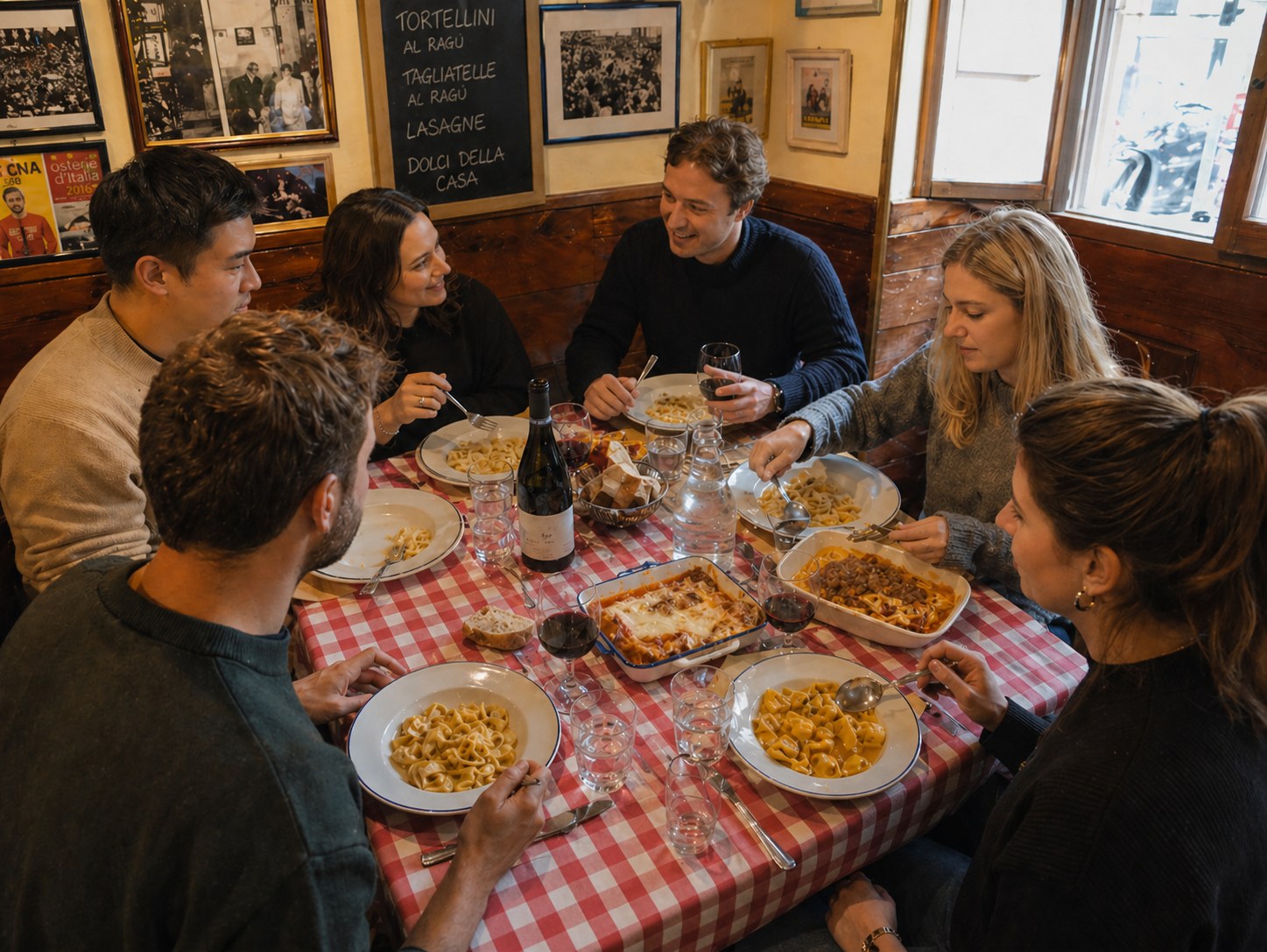
Bologna has been called La Grassa — the Fat One — for centuries. It's not an insult. It's a title of honour, a city's reputation earned by centuries of growing, curing, fermenting and rolling the best ingredients in Italy into the most satisfying food on the peninsula.
The problem is that a city known for food attracts restaurants that profit from that reputation without earning it. A lot of what visitors eat in Bologna — especially around Piazza Maggiore and the main tourist streets — is not the food that earned Bologna its name. It's a photocopy of a photocopy: dried pasta with tinned tomatoes, pre-sliced mortadella from a bag, industrial gelato with artificial colouring.
This guide is about the real thing. Here's what to eat in Bologna, what the authentic version looks and tastes like, and how to tell it from the tourist version.
1. Tagliatelle al ragù — not spaghetti bolognese
Let's start with the most famous and most abused dish. Bolognese ragù exists in Bologna, but it's served on fresh egg tagliatelle — never on spaghetti. If a restaurant in Bologna serves spaghetti bolognese, leave immediately.
The authentic ragù bolognese is a slow-cooked meat sauce (beef, often mixed with pork) in a base of soffritto — carrot, celery, onion — with a splash of wine, a little milk or cream, and very little tomato. It is rich, deeply savoury, and meaty without being heavy. It clings to the broad ribbons of fresh pasta rather than swimming in a pool of red sauce.
The tagliatelle should be freshly made — pasta fresca all'uovo — rolled by hand or at most by machine, not dried. The colour is deep gold from the egg yolks. The width of an authentic tagliatella, according to the Bologna Chamber of Commerce, must equal 1/12,270th the height of the Asinelli Tower. They have a legal gold standard. This is how seriously they take it.
What to look for: Fresh pasta made in-house, served on a plain white plate with no garnish. A bowl of grated Parmigiano on the side. No parsley, no truffle oil, no theatrical presentation. Just the pasta.
2. Mortadella — not prosciutto
Mortadella is Bologna's most iconic product and one of Italy's most misunderstood. It is not luncheon meat. It is not "baloney." It is a large, slow-cooked pork sausage made from finely ground high-quality pork, studded with cubes of fat and whole peppercorns, occasionally with pistachios. It is PGI-protected, meaning authentic mortadella can only be produced in Emilia-Romagna.
Eat it freshly sliced from a whole sausage, at room temperature, with a small amount of tigelle or crescentine (see below). The texture should be silky and the flavour delicate — nothing like the rubbery cold cuts that export markets have long associated with the name.
Where to find it: Any good salumeria in Bologna. Ask for it sliced thinly, by hand if possible, and eat it immediately. The moment it's sliced, the oxidation clock starts.
3. Tortellini in brodo — the dish the Bolognese eat when it matters
If tagliatelle al ragù is Bologna's everyday food, tortellini in brodo is its Sunday food, its Christmas food, its celebration food. These tiny hand-folded pasta rings filled with pork, mortadella, prosciutto and Parmigiano are served in a clear, slowly simmered capon or beef broth.
They are not served with cream sauce. That is a foreign corruption. In brodo — in broth — is the only authentic preparation. The broth takes hours to make and is everything: rich, clear, golden, deeply flavoured without being heavy.
Tourist restaurants often serve them in cream sauce because it takes less time and skill. If a menu says "tortellini alla panna" and nothing else, that's your signal.
4. Tigelle and crescentine — Bologna's street food
These are less famous outside Italy but just as important to daily life in Bologna. Tigelle are small round breads cooked on a griddle, traditionally eaten split and filled with mortadella, lard and rosemary, or cured meats and cheese. Crescentine (also called gnocco fritto in Modena) are fried dough pillows — light, airy, slightly salty — served with prosciutto and squacquerone (a fresh spreadable cheese).
You'll find them in traditional osterie and at aperitivo time in the right bars — not the tourist bars, the neighbourhood ones.
5. Parmigiano-Reggiano — the real thing, at the source
Bologna sits in the heart of Parmigiano-Reggiano country. The cheese produced in this area — aged for 24, 36 or even 48 months — is categorically different from the grated powder sold in plastic tubes. It should be eaten in pieces, broken from a wheel with a special knife, with a drop of aged balsamic vinegar from Modena.
A good cheese shop in Bologna will let you taste different ages. A 12-month Parmigiano is milky and mild. A 36-month one is granular, crystalline, almost sweet. The difference between them is worth understanding.
6. Artisan gelato — not the colourful peaks of foam
Bologna has exceptional gelato, but not all gelato is equal. The sign of industrially made gelato is large, brightly coloured mounds piled high above the display case. Artisan gelato is kept flat in covered metal containers — because real gelato doesn't need to be displayed in a tower of artificial colouring.
Look for small flavour selections, seasonal fruits, and muted, natural colours. Pistachio should be grey-green, not neon green. Stracciatella should be cream-white with brown chocolate chips, not bright white with thick chocolate swirls. The flavour of artisan gelato is in the ingredient, not the presentation.
7. Espresso — standing up, at the bar
Not a category of food exactly, but an essential part of eating in Bologna. Bolognese espresso is drunk standing at the bar — this is the social ritual of the Italian bar, not a drink you take to a table with a laptop. A well-made espresso in a good café costs €1 to €1.20 at the bar. If it costs more than €2 and you're standing in the centre of town, you're paying the tourist surcharge.
The coffee should be dense, dark and quickly consumed. No lingering over it — that's for filter coffee. The espresso is a punctuation mark in your day, not a destination.
Where to actually find authentic food
The short answer is: not on the main tourist streets, not on restaurant aggregator apps ranked by review count, and not in the places with photographs on the menu.
The longer answer involves knowing specific places — which is exactly what a food tour with a local is for. The places I take guests on my tour are ones I can vouch for personally: venues I've eaten at regularly for years, places where the owners know me and where the food is what it should be, not a performance of what tourists expect.
If you're doing Bologna on your own, walk away from the centre, into the residential streets of Santo Stefano, Mazzini, or San Donato. Look for places with handwritten menus, no photographs, and local clientele at lunchtime. Eat where the university students eat. Eat where the market workers eat after the morning shift.